I study the evolution of the Universe as we know it: how galaxies and the cosmic web grew out of tiny early fluctuations, and why the expansion of the Universe is accelerating today. Most of my work sits where theory meets observation, asking what large galaxy surveys actually measure and what those measurements can tell us about dark energy, dark matter and gravity itself.
What I'm working on now
At present I am thinking about whether the latest galaxy-survey data paint a consistent picture of how the Universe has expanded, about gravitational waves from merging compact objects, and about the nature of dark matter in the very early Universe.
Themes in my work so far
Dark energy and the Hubble tension
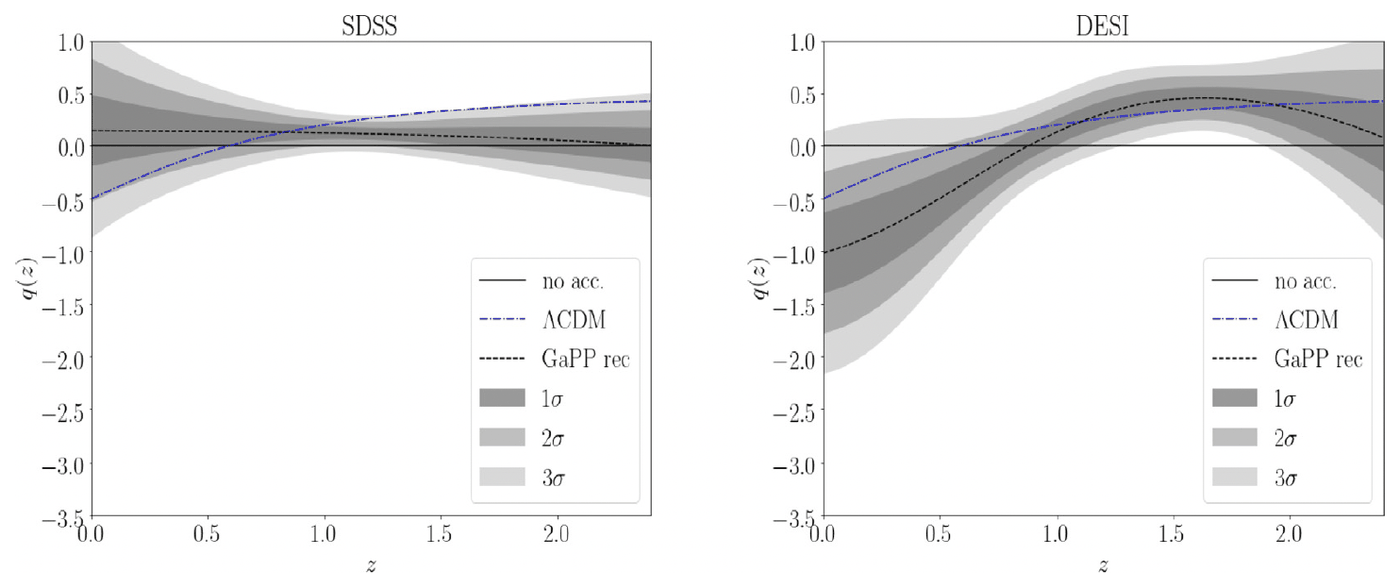
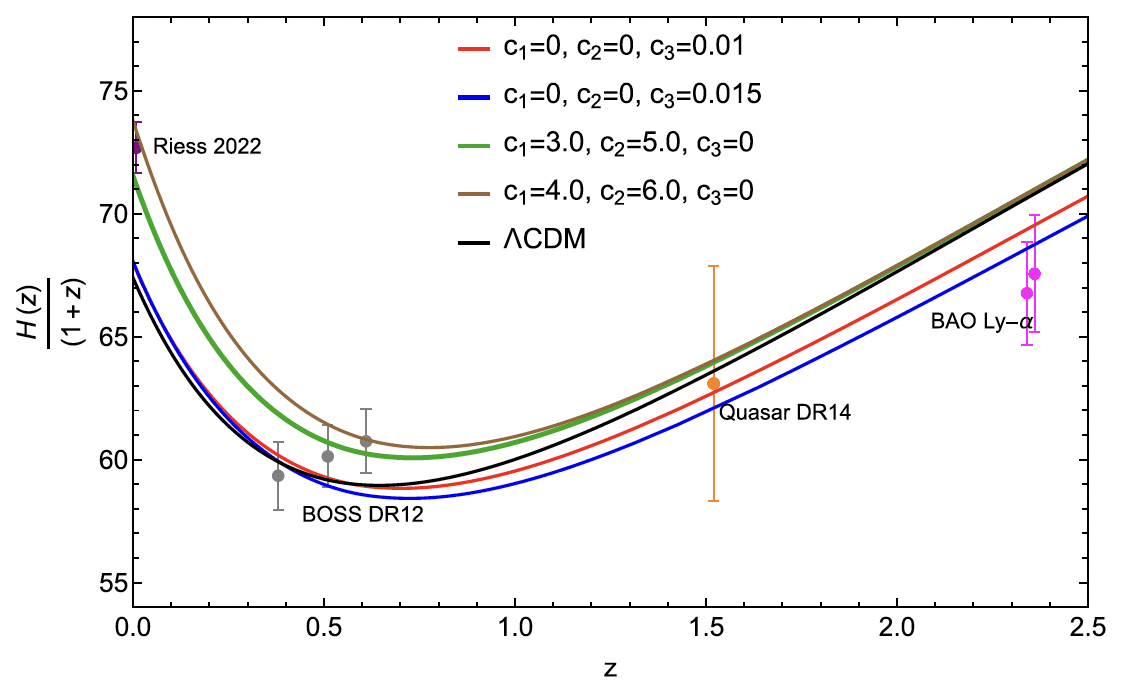
Measurements of today's expansion rate from the nearby Universe disagree with values inferred from the early Universe. I have explored whether dynamical dark energy within modified gravity theories can ease this tension, and whether baryon acoustic oscillation (BAO) measurements from different surveys agree with each other, using model-independent reconstructions of the expansion history.
Galaxy number counts and relativistic effects
We see galaxies not where they are, but where their light makes them appear. Gravitational lensing, redshift-space distortions and other relativistic effects all shift what we count. My PhD work developed full-sky descriptions of these observables, studied how lensing alters galaxy counts, and checked whether observables change under conformal and disformal transformations of the metric.
Testing gravity on cosmological scales
The Eg statistic combines lensing and galaxy clustering to test general relativity on cosmic scales. I worked on formulating it in terms of quantities surveys actually observe, and on modelling observables on smaller, non-linear scales.
Weak lensing and intrinsic alignments
Weak lensing measures the tiny, coherent distortions of galaxy shapes caused by intervening matter. But galaxies are also intrinsically aligned by the tidal fields they form in, which can mimic or mask the lensing signal. I have worked on shape and size correlations, higher-order lensing distortions (flexions), a unified alignment model for elliptical and disc galaxies, and whether lensing and alignments can break the distance-duality relation.
The papers behind each of these themes are listed on the Publications page.